
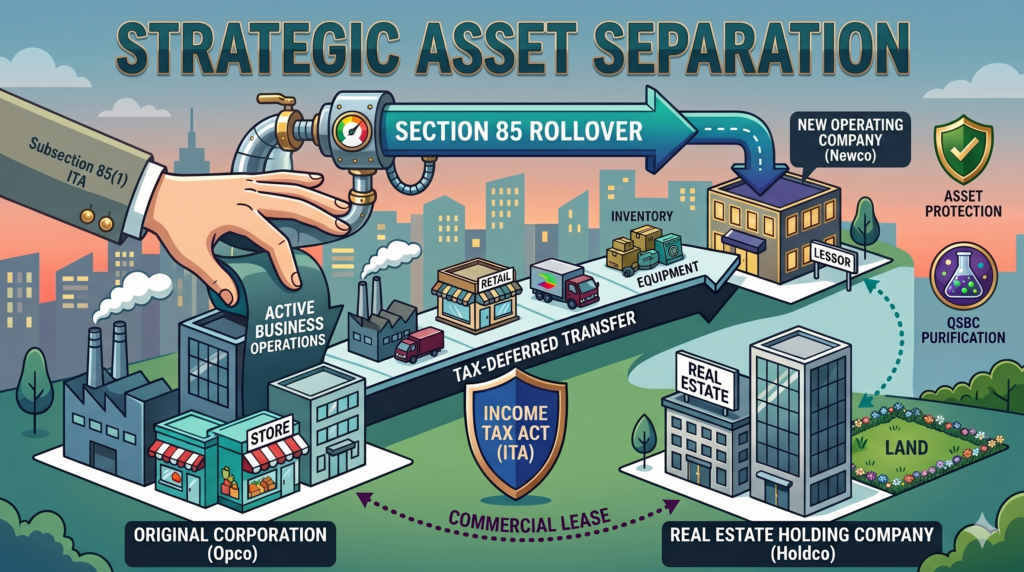
Strategic Asset Separation: Utilizing a Section 85 Rollover to Isolate Real Estate from Business Operations
As businesses mature, they often accumulate significant assets alongside their day-to-day operations. A common—and risky—scenario we see at Capstone LLP is a privately held corporation that houses both active business operations and highly appreciated passive assets, such as commercial real estate.
Holding real estate in an active operating company (Opco) exposes those valuable assets to the general creditors and liabilities of the business. Furthermore, it can jeopardize the shares’ status as Qualified Small Business Corporation (QSBC) shares under subsection 110.6(1) of the Income Tax Act (ITA), potentially disqualifying the shareholders from claiming the Lifetime Capital Gains Exemption (LCGE).
To mitigate these risks, CPAs and tax practitioners frequently employ a tax-deferred transfer of assets under subsection 85(1) of the ITA. This technical guide outlines how a Section 85 rollover can be utilized to legally and financially separate business operations from real estate, effectively creating a “purified” corporate structure.
The Strategy: Transferring the Active Business
When separating real estate from operations, the immediate thought is often to transfer the real estate to a new holding company. However, in jurisdictions like Ontario, transferring real estate often triggers Land Transfer Tax (LTT).
A more tax-efficient strategy is the inverse: transferring the active business operations to a newly incorporated entity (Newco), while leaving the real estate behind in the original corporation. The original corporation ceases active operations, effectively transforming into a Real Estate Holding Company (Holdco), which leases the property to Newco.
This strategy requires a meticulous application of subsection 85(1) to ensure the transfer of the business assets (inventory, goodwill, equipment) occurs on a tax-deferred basis.
Technical Mechanics of Subsection 85(1)
Subsection 85(1) of the ITA allows a taxpayer to transfer “eligible property” to a Taxable Canadian Corporation (TCC) for an elected amount. This elected amount becomes the proceeds of disposition for the transferor and the cost base for the transferee, effectively deferring capital gains, terminal losses, and recapture of capital cost allowance (CCA).
Key Statutory Parameters:
- Eligible Property (ss. 85(1.1)): Includes capital property (e.g., goodwill, equipment), depreciable property, and inventory (excluding real property inventory).
- Consideration (ss. 85(1)(a)): The transferor must receive consideration that includes shares of the capital stock of the transferee corporation.
- Elected Amount Limitations: The elected amount cannot be:
- Less than the Fair Market Value (FMV) of the non-share consideration received (boot) [ss. 85(1)(b)].
- Greater than the FMV of the transferred property [ss. 85(1)(c)].
- For depreciable property, less than the least of the Undepreciated Capital Cost (UCC), the cost of the property, and its FMV [ss. 85(1)(e)].
Example of The Steps Typically Involved
To properly execute this reorganization, the accounting steps must be meticulously translated into legal documentation. Below is a framework of instructions typically provided to corporate legal counsel to undertake the Section 85 rollover.
Step 1: Incorporation and Organization of Newco
- Incorporate a new corporation (Newco) under the relevant provincial or federal business corporations act. Newco will act as the new operating entity.
- Share Capital: Ensure Newco’s articles of incorporation authorize an unlimited number of common shares and at least one class of redeemable, retractable preferred shares (Rollover Preferred Shares).
- Share Attributes: The Rollover Preferred Shares must have a redemption and retraction amount equal to the FMV of the consideration received by Newco, less the FMV of any non-share consideration issued. They must also have a voting right to ensure control, if necessary, for associated corporation rules (s. 256).
Step 2: The Asset Transfer Agreement
- Draft an Asset Purchase Agreement between Opco (Transferor) and Newco (Transferee) with an effective date at the end of Opco’s current financial period or an agreed-upon interim date.
- Assets Transferred: Specify all active business assets, including:
- Accounts Receivable
- Inventory
- Prepaid Expenses
- Machinery, Equipment, and Vehicles (Depreciable Property)
- Intangibles and Goodwill
- Assets Excluded: Explicitly exclude the real estate, which will remain in Opco.
Step 3: Assumption of Liabilities and Issuance of Consideration
- Assumed Liabilities: Newco will assume the active trade payables and operational liabilities of Opco. Under the ITA, assumed liabilities constitute non-share consideration (boot).
- Promissory Note: To the extent that the tax cost (e.g., UCC, Adjusted Cost Base) of the transferred assets exceeds the assumed liabilities, Newco will issue a demand promissory note to Opco. The total boot (liabilities assumed + promissory note) must not exceed the tax cost of the transferred assets to prevent triggering premature tax [ss. 85(1)(b)].
- Rollover Preferred Shares: Newco will issue Rollover Preferred Shares to Opco. The aggregate redemption value of these shares must equal the FMV of the assets transferred minus the total non-share consideration (boot) paid.
Step 4: The Price Adjustment Clause (PAC)
- CRITICAL REQUIREMENT: Draft a standard Price Adjustment Clause into the Asset Purchase Agreement and the articles detailing the Rollover Preferred Shares.
- Because the FMV of assets like Goodwill is subjective, the Canada Revenue Agency (CRA) may challenge the valuation. A PAC ensures that if the CRA successfully adjusts the FMV of the transferred property, the redemption value of the Rollover Preferred Shares and the principal amount of the promissory note will be automatically adjusted to avoid adverse tax consequences (such as a shareholder benefit under subsection 15(1) or a deemed dividend). Reference CRA Income Tax Folio S4-F3-C1, Price Adjustment Clauses.
Step 5: Commercial Lease Agreement
- Draft a Commercial Lease Agreement between Opco (now acting as the Landlord/Holdco) and Newco (the Tenant/Operating entity). This establishes a formal, arm’s-length-style relationship for the use of the real estate, ensuring the real estate entity generates passive rental income.
Step 6: Required Tax Elections
- Section 85 Election: Advise the client that Capstone LLP will prepare the CRA Form T2057, Election on Disposition of Property by a Taxpayer to a Taxable Canadian Corporation. This must be filed on or before the earliest day on which either Opco or Newco has to file a tax return for the taxation year in which the transfer occurs [ss. 85(6)].
- Accounts Receivable Election: Prepare the joint election under Section 22 of the ITA, allowing Newco to claim bad debt deductions on the transferred receivables.
- GST/HST Election: Prepare the joint election under Section 167 of the Excise Tax Act (ETA) (Form GST44) so no GST/HST is payable on the sale of the business assets.
Conclusion
By executing a Section 85 rollover to shift operations into a Newco, business owners can successfully ring-fence their valuable real estate from operational liabilities without incurring an immediate tax burden. While highly effective, this strategy requires strict adherence to the ITA, precise valuations, and seamless coordination between your CPA and corporate legal counsel.
If you are a business owner looking to protect your hard-earned assets or prepare your company for a future sale, contact our tax specialists at Capstone LLP. We can design and execute a tailored corporate tax restructuring plan that secures your wealth and optimizes your tax position.
The information provided in this article is intended for general educational purposes only and does not constitute official legal, accounting, or tax advice. Because corporate tax strategies and the