
As a dentist practicing in Ontario, reaching a certain level of professional and financial success often prompts a critical question: Is it time to incorporate? Forming a Dental Professional Corporation (DPC) can unlock significant tax planning opportunities, accelerate debt repayment, and facilitate long-term wealth accumulation. However, it also introduces rigorous regulatory compliance and complex tax considerations.
At Capstone LLP, we specialize in guiding dental professionals through the intricacies of corporate tax planning. In this article, we outline the fundamental requirements for establishing a DPC and discuss the key financial indicators that signal it is time to incorporate.
RCDSO Requirements for a Dental Professional Corporation
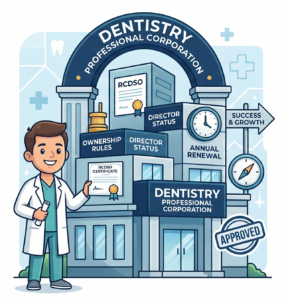
Unlike a standard business incorporation, a DPC is governed by strict provincial regulations. To legally practice dentistry through a corporation in Ontario, you must obtain a Certificate of Authorization from the Royal College of Dental Surgeons of Ontario (RCDSO).
Here are the primary regulatory requirements your corporation must meet to be approved:
- Jurisdiction: The corporation must be established under the Business Corporations Act (Ontario). Federal corporations are not permitted for Ontario DPCs
- Naming Conventions: The corporate name is strictly regulated. It must include your surname as it appears on the RCDSO register (and may optionally include your given names or initials) and must end exactly with the words “Dentistry Professional Corporation”
- Share Structure & Ownership: * Voting Shares: All voting shares must be legally and beneficially owned by one or more dentists licensed by the RCDSO
- Non-Voting Shares: Non-voting shares may be owned by specific family members (the dentist’s spouse, children, or parents) or by a trust for the benefit of minor children
- Directors and Officers: Every director and officer of the corporation must be a licensed dentist who is also a shareholder of the DPC
- Application Process: You must submit a complete application to the RCDSO, including a copy of the Articles of Incorporation, a recent Corporation Profile Report, the signed Shareholder Undertaking forms, and the non-refundable application fee.
Important Note: A Certificate of Authorization is not permanent; it must be renewed annually by August 31st to maintain your corporate status with the College
When Does It Make Sense to Incorporate?
Incorporating comes with upfront legal and accounting costs, as well as ongoing annual maintenance fees (such as filing T2 corporate tax returns and handling RCDSO renewals). Therefore, incorporation is generally recommended only when the financial benefits significantly outweigh the administrative burden.
Consider forming a DPC if your situation aligns with the following scenarios:
- You Earn More Than You Need for Personal Living Expenses
If your practice generates surplus cash flow beyond what you need to fund your personal lifestyle, a DPC allows for substantial tax deferral. In Ontario, active business income left inside the corporation is taxed at the small business rate of 12.2% (on the first $500,000), compared to the top marginal personal tax rate, which exceeds 53%. Retaining funds in the corporation allows you to invest the difference, effectively compounding your wealth with pre-tax dollars.
- You Are Aggressively Paying Down Practice Debt
Because corporate tax rates are significantly lower than personal tax rates, a DPC allows you to use “cheaper” corporate dollars to pay down the principal on business loans. If you have borrowed heavily to purchase a practice or buy expensive operatory equipment, paying off that debt through the corporation is highly tax-efficient.
- You Are Planning for the Future Sale of Your Practice
If structured correctly with Qualifying Small Business Corporation (QSBC) shares, selling your dental practice through a DPC allows you to utilize the Lifetime Capital Gains Exemption (LCGE). As of 2026, the LCGE limit can shelter up to $1,275,000 in eligible capital gains from tax upon the sale of your qualifying shares, providing a massive tax windfall at retirement.
Strategic Tax Planning with Capstone LLP
Deciding to incorporate is a major milestone in your dental career. While the tax deferral and wealth accumulation benefits are immense, the regulatory framework requires careful, proactive navigation.
If you are considering incorporation or need assistance setting up your Dental Professional Corporation in compliance with RCDSO and Canada Revenue Agency guidelines, contact the expert CPAs at Capstone LLP today to schedule a consultation.